STAGE ONE… EXPLORATORY PLAY… TOY LIST
Remember… The only way babies learn what words mean (and to talk!) is by hearing you say the same key words over and over. As you play, pick one or two key words per toy and repeat those words many times each time you play. Examples are listed for each recommended toy and you can watch demonstrations of how to use the toy at podcast #466.
In January 2024, Amazon changed the way affiliates post links. For now, we’re stuck with the short links.
Fabric Balls
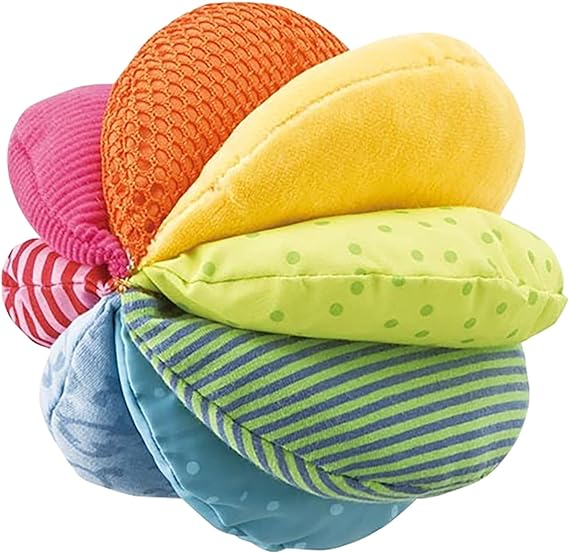
Here’s a wonderful first ball for holding, grasping, and exploring while using both hands to develop motor coordination. It’s a great choice for tummy time because the ball rolls and encourages movement, but it’s easy to grasp. Your key word here is, of course, ball! Say the word “ball” many times as you talk about how the ball looks and feels as the child explores the ball. For example, “Here’s the ball. Ball. Wow! Look! Ball! You are holding the ball. Ball! Oooh… this part feels soft. Ball! Mmmm… you put the ball in your mouth. Ball.”
FABRIC BALL https://amzn.to/45oyIJ4
Spinning Drum
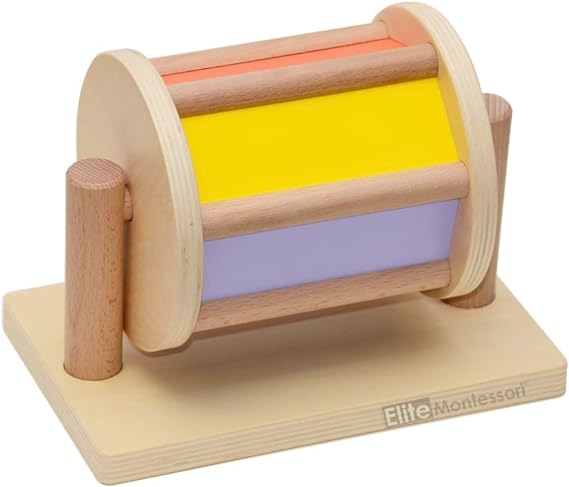
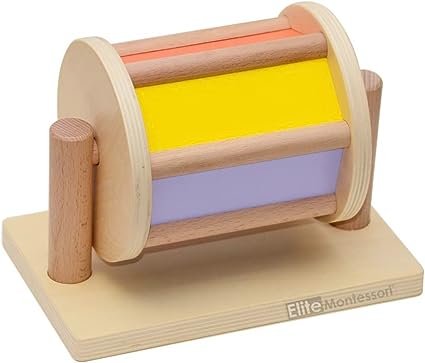
This simple spinning drum is very easy to spin and mesmerizing for children to watch as they begin to learn how to activate toys. For your key words, try something like “Go” or “Whee” as the child spins the wheel.
SPINNING DRUM https://amzn.to/3ORofyM
Mirror Puzzle
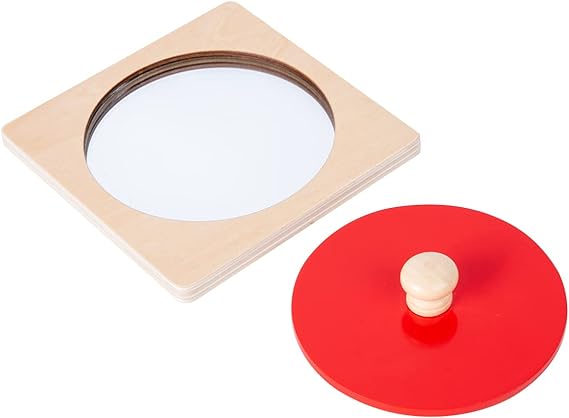
The knobbed puzzle is a great surprise as babies uncover the mirror and recognize and smile at themselves. Mirror toys are a fantastic tool to use during Stage 1. Help a baby learn to grab the knob and push it over to reveal the mirror. Say something like, “Get it! Oooohhhhh…. Look! Who is that? Ahhh… it’s (baby’s name).”
MIRROR PUZZLE https://amzn.to/3socVmr
Tissue Box
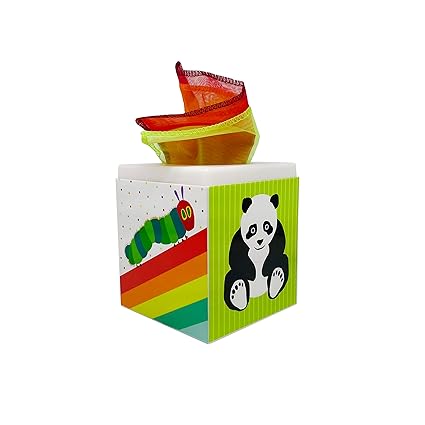
This tissue box comes with crinkly papers perfect for teaching babies to listen as they play. As a child grabs each piece, the texture provides important tactile feedback to their little hands. Even though most babies learn nouns (names for people, places, and things) first, you can choose verbs during play routines. For key words, you might choose “pull” as a baby learns to grab the tissues out of the box as you exaggeratedly say something like, “Puuuuuuuull that tissue out.” You might even choose a word like “Listen! Do you hear that? Listen!” as you crinkle the tissues yourself to help a baby attend to the new sound.
TISSUE BOX https://amzn.to/3EciZ46, https://amzn.to/47Oj6QI
Penguin Wobbler
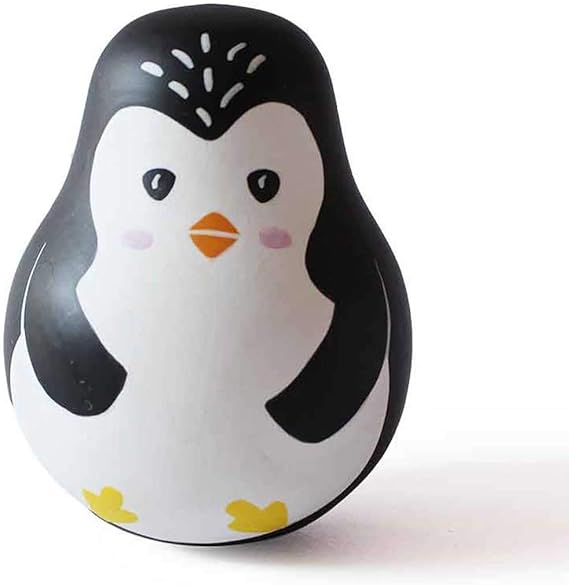
This classic toy helps increase eye-hand coordination and muscle strength. It’s just the right size for their little hands to push and nudge again and again. Babies in the earliest stages of language development like listening to you use sound effects as you play together. For this toy, say something like, “Whoa! Whoa! Push it! Whoa!” or another silly sound as your child pushes the wobble toy. Be sure you’re pointing to the wobbler to help your child learn to follow your point with his eyes – which happens officially in the next stage of play, but we always want to set the stage for what’s to come.
Earliest Shape Sorter
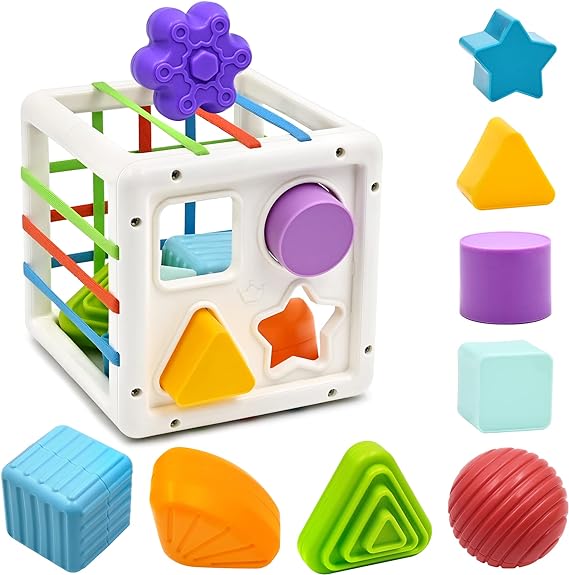
I love this toy for later in this stage as a baby begins to learn to put things in and pour things out. Filling and dumping, as well as, figuring out where things fit are primary play activities for children until they’re 3. This beginning toy introduces them early problem solving as the learn to push shapes through the slots, but without the frustration! While colors and shape words are the natural targets for this toy, children in this stage won’t be ready to learn academic words like these for quite a while. Try describing how the toys works and using plenty of exclamatory words that attract a baby’s attention by saying something like, “Oooooh…. try that one! Push it in! Oooohhh… in! Woo-hoo! You did it!”
SHAPE SORTER https://amzn.to/3PaW1QX
Rain Stick Rattle
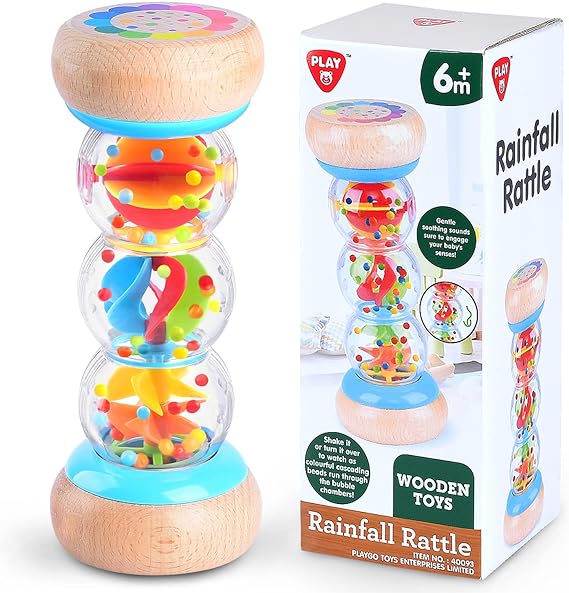
This easy to grip rattle gives children something to look at and listen to as they turn it over, shake it, or roll it around. Say something like, “Wow… Look! Let’s roll! Roll… Wow!” Encourage mobility as you help a child learn to reach, scoot, or roll to begin the play routine again.
RAIN STICK RATTLE https://amzn.to/45kPwAF
Container Play
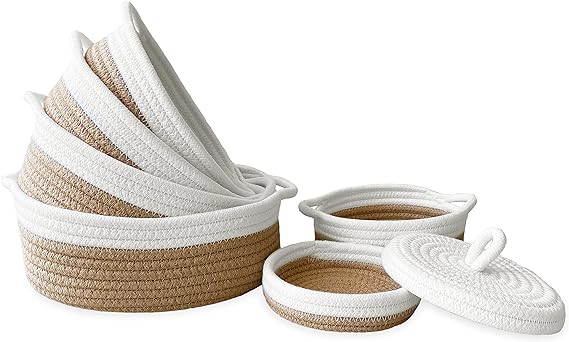
My favorite idea for children is Stage 1 to promote exploratory play is container play. Your primary goal at this level is for the toddler to do new things with toys and familiar objects. For this you’ll need a container like a large bowl, bucket, or even an empty baby wipe box if you can find it! Gather a variety of 10 or so interesting items. Make sure to provide as much variety as possible. For example, you could include a bell (something to hear), a teething toy that vibrates (something to feel as it moves), a toy car (something with parts that move), two or three blocks (something to bang or push around), a Sophie giraffe (something interesting to chew, look at, and grasp), a soft doll (something to look at and pat), a Bendy ball (something to chew, grasp, shake and roll), and a set of small nesting cups (something to handle and fit together).
Sit down on the floor and shake the container to capture your child’s interest. Say something like, “Oh… get ready! Here’s something fun! See?” When the child is close to you, show him the items in the container. Put your hand in and shuffle the items around and then pull out an item. Perform a simple action or two like shaking, rolling, banging on the floor, etc. Talk about what you’re doing using super simple language such as, “Blocks! One block. Two blocks. Bang! Bang! Bang!” Give the child the item and watch his response. If he needs assistance, take his hands and help him perform a new action with the item as you talk about what he’s doing. Model various reactions as you explore items with your sounds, words, tone of voice, and facial expressions.
CONTAINER PLAY https://amzn.to/45nM8VJ
Rolling Mirror Toy
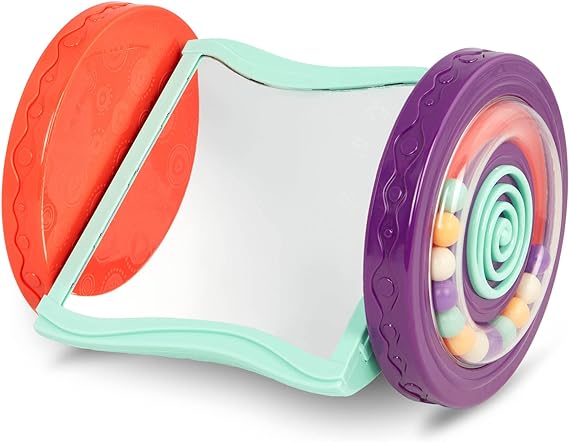
As we said before, mirror toys are always a great idea for any child who is in Stage 1. This one also combines a movement challenge since the mirror will roll away and the child is motivated to try to move toward his own reflection. As you’re playing together, tap the mirror to help a child look at himself. Say something like, “Look! Look! See! Who is that baby? That’s ____. I see ____. Look it’s _____.”
ROLLING MIRROR https://amzn.to/44q3Jv9
Soft Dolls
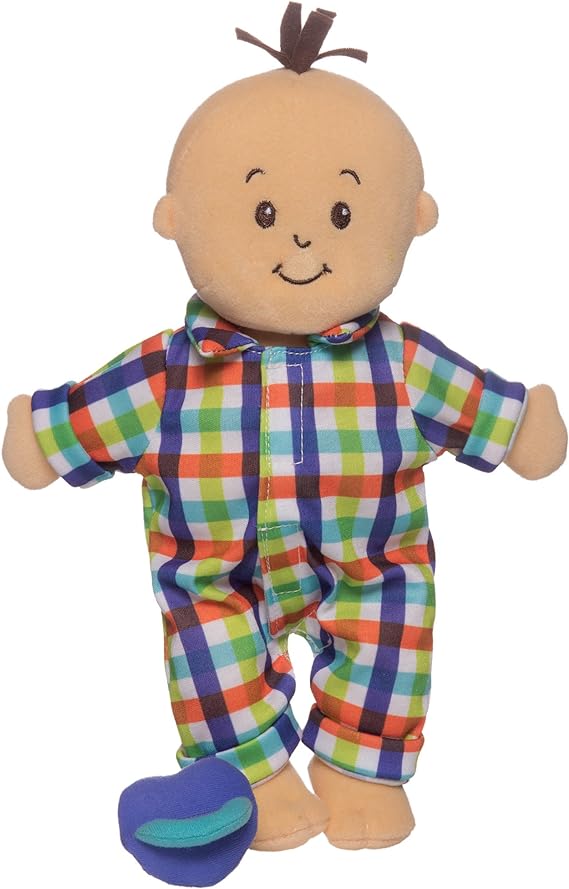
Boys and girls alike learn so much from playing with baby dolls from body parts to early pretending, but this in this stage of play, a soft cloth baby doll can be something comforting to look at, hold, manipulate, and mouth. Your key word here will probably be “baby.” Talk about what your child is paying attention to on the baby such as, “Baby! I see your baby’s mouth. Look! Baby’s mouth. Baby.”
Wooden Rattles
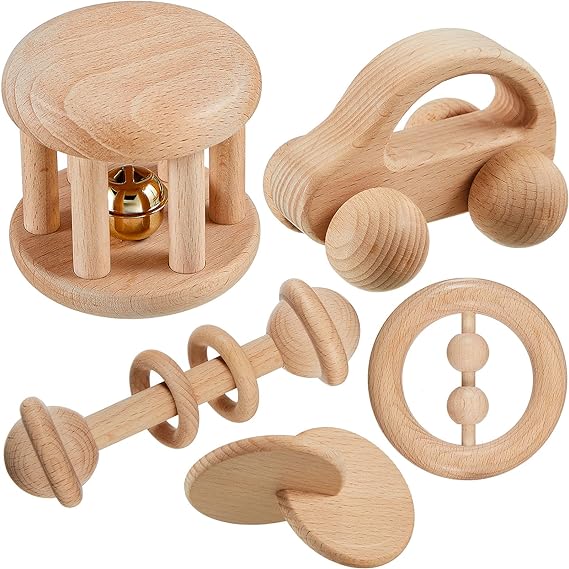
These wooden rattles help a child learn to hold, shake, grasp, and transfer toys from hand to hand. As a child is looking at the bell rattle, say something like, “Wow! Listen! I hear a bell!” then ring the bell or as a child is holding a rattle say something like, “Shake – shake – shake! You can shake that rattle. Shake – shake!”
WOODEN RATTLES https://amzn.to/3P9pjzk
Links
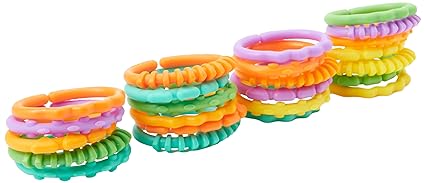
Plastic link toys are ideal for helping little ones learn to use their hands and they’re also safe to chew! Join links together and hook them to a stroller or car seat so the child has something to reach for and hold. Say something like, “See! Look at those links! Hook – hook! We hooked those links together.” Or “Whoa! I can pull this link! Watch – pull!”
PLASTIC LINKS https://amzn.to/460GokX
Here’s a set and it looks like a great value if you need most of these toys. This would make a great gift for a child who is in this stage!
Get My Free eBook
A Parent's Guide to Understanding Speech Language Development
Browse Products
Featured Product
Recent Posts
Teach Me To Talk Testimonials
Happy Therapists, Teachers, Parents & Children
"I just want to thank you for the invaluable information you’ve given me in helping my grandson to talk (which I have passed on to his parents). We’ve ve learned patience, appropriate expectations, and fun and effective strategies that we had found no where else. He is exploding with conversation! Sometimes I struggle to interpret his articulation, but all I have to do is say, “Show me”, and he’s excited to do so. He and I both want so badly to communicate with each other, and your strategies have made it so much easier and non-threatening. Once again, I thank you from the bottom of my heart."
Stacey
"My little guy is taking off like a rocket!! We’ve been working through your Autism Workbook for a few months and he has had an explosion of skills develop. YOU are AMAZING! THANK YOU!" Laura Q, Mom
"Dear Laura Mize and Team,
Thank you so much for all your hard work and publishing books! Our 17-month-old toddler suddenly exploded into speaking and imitating everybody's gestures and sounds, just a week or two after we 'completed' all activities that are listed under 11 pre-linguistic skills! Your method really works!"
Grateful customer.
"Hi Laura!
I absolutely LOVE all of your workbooks, especially your Autism Workbook. Starting with Social Games has been a game changer for many of my littles with ASD and their families. It's been the best way for them to finally connect and sustain shared attention and engagement, leading to longer social interactions, through play!"
Jodie, Dev, Therapist
"Hi Ms. Laura,
Thank you so much for the videos you have posted on your youtube channel. They are so direct, informative, and helpful. Thank you for being a resource for me to become a better therapist."
Dianne
"Gosh, I love all of your emails/podcast/website, just everything!! I work in early intervention as a behavior analyst and am learning so much from you!"
Thank you!
Hailey
"Laura,
I love your work! I am a professor of early childhood special education and a speech language pathologist! I have worked to help children learn to communicate and I know how valuable the information you share is for both early interventionists and pediatric speech language pathologists!
Thank you for systematically organizing and explaining essential steps for young children to learn and develop. You are having a great impact on our profession, the ECE profession and families!"
Sincerely,
David
"Thank you.
If this is Laura herself reading this email let me take this opportunity to thank you from the bottom of my heart for all that you have put forth for us professionals. I own every manual (except the autism manual) and have watched every course on DVD. I have listened to countless podcasts. All of what I’ve come to be as an Early Intervention speech therapist was absolutely to your credit. With your resources at my side I have never needed to scramble for answers and strategies and above all the clear language I use when communicating with parents. My fun, animated affect and key phrases I use have been learned through watching your example. So….thank you! May you be blessed."
Chaya
"I just wanted to thank you so much for your incredible help! You are so kind and lovely and every time I implement something you've taught in your manuals or videos it is always a success, I cannot thank you enough. I really appreciate how specific you are in giving us examples of wording to use and how to use a toy in therapy with your videos, it is exactly what I need to properly help my little students. I also really appreciate your list of books of list of toys. I have seen my little students make significant progress thanks to you. I'm looking forward to watching more of your videos, taking more of your CEU's, and reading more of your materials. From the bottom of my heart: thank you so much again!!"
Lauren
Laura thank you so much. Btw, you have transformed my therapy- I have become such a competent and strong therapist after watching probably like 350 of your videos and podcasts over the past few years. And I am a seasoned therapist with almost 25 years experience. (Yes prob 350 episodes ha!) But there was still a lot I learned from you. I have such a thorough understanding of birth to 3 development and how to properly incorporate appropriate therapeutic goals, techniques and strategies now, thanks to you. Kelly
