FUNctional Phonology
For speech-language therapists, the best part is learning how to teach parents what to do at home. All this information lines up perfectly with a parent coaching model. You’re telling parents, “This is what you can do during your everyday routines at home to help improve your child’s ability to be understood.” You’ll also get lots of other tools too- checklists for deciding who is and who is not ready to work on articulation (best for helping justify your decision to eager families!), a form to help you prioritize your first therapy goals, cheat sheets for how to cue consonant AND vowel sounds, plus TONS of developmentally appropriate therapy activities that work in clinic, preschool, and home settings.
$58.00
Description
Do you need help working with a late-talking toddler who is also unintelligible?
I have a great tool for you!
It’s my therapy manual Functional Phonology and it’s filled with practical information to help you address speech intelligibility in toddlers.
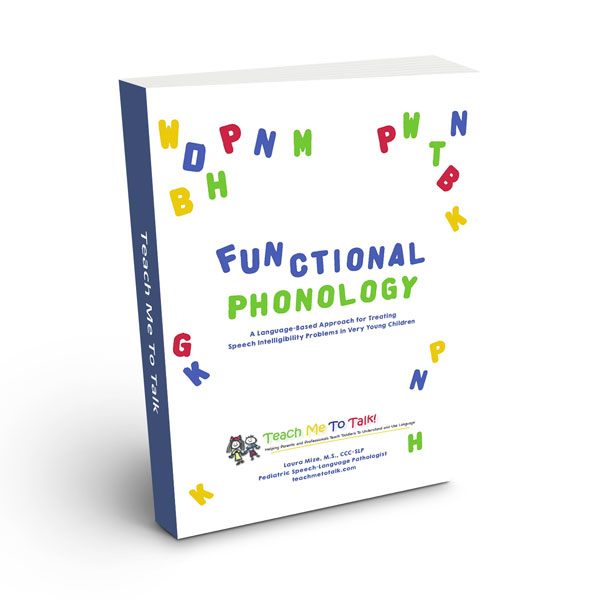
FUNctional Phonology: A Language-Based Approach for Treating Speech Intelligibility Problems in Very Young Children
You can’t address a toddler’s articulation skills with methods recommended for older kids without some tweaks! Let me show you how to modify what you do so that you can be more effective.
If you’re a parent and aren’t sure HOW to cue a child to change the way he pronounces words, then this therapy manual is definitely for you!
For therapists, the best part is learning how to teach parents what to do at home.
The subtitle of this therapy manual should really be…
“I don’t like to focus on articulation with toddlers, but when I do, here’s what works best.”
If you’ve followed my work for any length of time, you know that I’m a self-described “language-language-language” therapist. I will ALWAYS believe that WHAT a toddler says is much more important than HOW he says it.
But…
Clearly, there are times when we should address speech intelligibility in toddlers.
That’s what this therapy manual is all about… helping you know who’s ready to work on speech intelligibility, who’s not, what to do to get them ready, and then finally, what to work on and how to work on it. Whew! That’s a mouthful, but it’s the summary of the manual.
This program is based on teaching (correcting!) early phonological patterns – which is how speech develops in toddlers – but it’s also language-based meaning that your target words are completely relevant and functional for toddlers – not random words that fit the speech sound or pattern but provide no “real life” application for 2 and 3-year-olds!
You’ll also notice the word FUN capitalized in the title. I won’t do anything with a little friend that’s not fun! Let’s face it… working on changing how a young child says a word can be t.o.r.t.u.r.e for everyone involved. To combat that problem, I’ll give you play-based therapy activities as well as practical ways (and words!) to use during everyday routines for families at home… It’s SUPER FUNCTIONAL.
Here’s the outline from the Table of Contents with a brief description of what you’ll find in each chapter:
Chapter 1… Is There a Problem?
Red Flags That Indicate a Significant Speech Intelligibility Problem in Toddlers
Chapter 2… Guidelines to Determine Readiness… To Treat or Not to Treat?
Learn the 7 factors that tell you when a child is developmentally ready to target speech intelligibility and when he’s not. You’ll also find recommendations for how to proceed when a toddler is not ready yet. I’ve included a great checklist to use with families, especially useful when parents are pushing you to address artic goals when you know there are other things that you should address first.
Chapter 3… Prioritize Your Goals
Read an Overview of the 6 Priority Patterns to Increase Speech Intelligibility in Toddlers. I’ve tweaked these patterns based on newer research. You’ll also get another great yes/no checklist to help you informally assess a toddler’s status with each of the priorities so that you can easily determine your goals and share your clinical decision-making process with parents.
Chapter 4… Principles for Designing Sessions for Toddlers
Essential tips for achieving success with toddlers while working on speech intelligibility including how to:
- Keep it Fun!
- Keep it Real!
- Keep it Realistic!
- Keep it Meaningful!
- Keep it Moving!
- Keep it Easy (Enough)!
- Keep it Going! Involving Families, Teachers, and Other Important People
Chapter 5… Tips for Teaching Toddlers New Sounds, Patterns, and Words
Fantastic “how-to” information for parents and for therapists! You can’t use the same methods for treating artic in toddlers as you do with older kids. Learn some tricks that work!
Chapter 6… Treatment Strategies and Activities to Target The 6 Priority Patterns
Here’s THE MEAT of the MANUAL! You’ll get:
- A description of each of the six patterns you’ll target and why it’s important for improving intelligibility
- A list of my BEST treatment tips to get you started as you begin to teach a toddler the new pattern
- Potential word lists for each priority beginning with a list of First Targets that are the easiest to produce and (hopefully!) the most relevant and functional for a toddler. By easiest, I mean that the word contains sounds in the most facilitative contexts for success. You’ll get next sets of words containing the pattern in more difficult contexts too so that you can “bump up” kids who are ready
- An entire section of activity ideas that have worked well with toddlers over the years in my own practice. Activities are organized into Moving Around and Sitting Down options to help you implement my “Move – Sit – Move – Sit” philosophy. This is a critical piece of success and failure during sessions with toddlers.
- EASY ideas for targeting the pattern during everyday routines at home. Therapists can use these recommendations to share with parents as “homework” between sessions. Parents can get this information directly to work on speech all day, every day.
- To wrap up this chapter, there’s a section on Troubleshooting with ideas to try when the initial recommendations are not working.
Chapter 7… What is This? Diagnostic Information for Speech Intelligibility Issues in Toddlers
Get information related to the 5 main diagnoses that result in unintelligible speech including speech delay, phonological disorder, dysarthria, childhood apraxia of speech, and lastly, some information about autism and speech intelligibility. This section will help clear the murkiness that occurs when we try to sort out a firm diagnosis in a very young child who is not easily understood.
All this information lines up perfectly with a parent coaching model. You’re telling parents, “This is what you can do during your everyday routines at home to help improve your child’s ability to be understood.” You’ll also get lots of other tools too- checklists for deciding who is and who is not ready to work on articulation (best for helping justify your decision to eager families!), a form to help you prioritize your first therapy goals, cheat sheets for how to cue consonant AND vowel sounds, plus TONS of developmentally appropriate therapy activities that work in clinic, preschool, and home settings.
Additional information
| Weight | 2.0 lbs |
|---|
Teach Me To Talk Testimonials
Happy Therapists, Teachers, Parents & Children
"I just want to thank you for the invaluable information you’ve given me in helping my grandson to talk (which I have passed on to his parents). We’ve ve learned patience, appropriate expectations, and fun and effective strategies that we had found no where else. He is exploding with conversation! Sometimes I struggle to interpret his articulation, but all I have to do is say, “Show me”, and he’s excited to do so. He and I both want so badly to communicate with each other, and your strategies have made it so much easier and non-threatening. Once again, I thank you from the bottom of my heart."
Stacey
"My little guy is taking off like a rocket!! We’ve been working through your Autism Workbook for a few months and he has had an explosion of skills develop. YOU are AMAZING! THANK YOU!" Laura Q, Mom
"Dear Laura Mize and Team,
Thank you so much for all your hard work and publishing books! Our 17-month-old toddler suddenly exploded into speaking and imitating everybody's gestures and sounds, just a week or two after we 'completed' all activities that are listed under 11 pre-linguistic skills! Your method really works!"
Grateful customer.
"Hi Laura!
I absolutely LOVE all of your workbooks, especially your Autism Workbook. Starting with Social Games has been a game changer for many of my littles with ASD and their families. It's been the best way for them to finally connect and sustain shared attention and engagement, leading to longer social interactions, through play!"
Jodie, Dev, Therapist
"Hi Ms. Laura,
Thank you so much for the videos you have posted on your youtube channel. They are so direct, informative, and helpful. Thank you for being a resource for me to become a better therapist."
Dianne
"Gosh, I love all of your emails/podcast/website, just everything!! I work in early intervention as a behavior analyst and am learning so much from you!"
Thank you!
Hailey
"Laura,
I love your work! I am a professor of early childhood special education and a speech language pathologist! I have worked to help children learn to communicate and I know how valuable the information you share is for both early interventionists and pediatric speech language pathologists!
Thank you for systematically organizing and explaining essential steps for young children to learn and develop. You are having a great impact on our profession, the ECE profession and families!"
Sincerely,
David
"Thank you.
If this is Laura herself reading this email let me take this opportunity to thank you from the bottom of my heart for all that you have put forth for us professionals. I own every manual (except the autism manual) and have watched every course on DVD. I have listened to countless podcasts. All of what I’ve come to be as an Early Intervention speech therapist was absolutely to your credit. With your resources at my side I have never needed to scramble for answers and strategies and above all the clear language I use when communicating with parents. My fun, animated affect and key phrases I use have been learned through watching your example. So….thank you! May you be blessed."
Chaya
"I just wanted to thank you so much for your incredible help! You are so kind and lovely and every time I implement something you've taught in your manuals or videos it is always a success, I cannot thank you enough. I really appreciate how specific you are in giving us examples of wording to use and how to use a toy in therapy with your videos, it is exactly what I need to properly help my little students. I also really appreciate your list of books of list of toys. I have seen my little students make significant progress thanks to you. I'm looking forward to watching more of your videos, taking more of your CEU's, and reading more of your materials. From the bottom of my heart: thank you so much again!!"
Lauren
Laura thank you so much. Btw, you have transformed my therapy- I have become such a competent and strong therapist after watching probably like 350 of your videos and podcasts over the past few years. And I am a seasoned therapist with almost 25 years experience. (Yes prob 350 episodes ha!) But there was still a lot I learned from you. I have such a thorough understanding of birth to 3 development and how to properly incorporate appropriate therapeutic goals, techniques and strategies now, thanks to you. Kelly

Reviews
There are no reviews yet.